Sign and display installation
Delivered and put in place on the same vehicle
A finished sign or a kiosk is a difficult thing to handle. It is heavier than it looks, it has one good face that must not be marked, and it has to end up square and level in an exact position. Delivering it on a flatbed and leaving it on the floor solves half the problem and creates the other half.
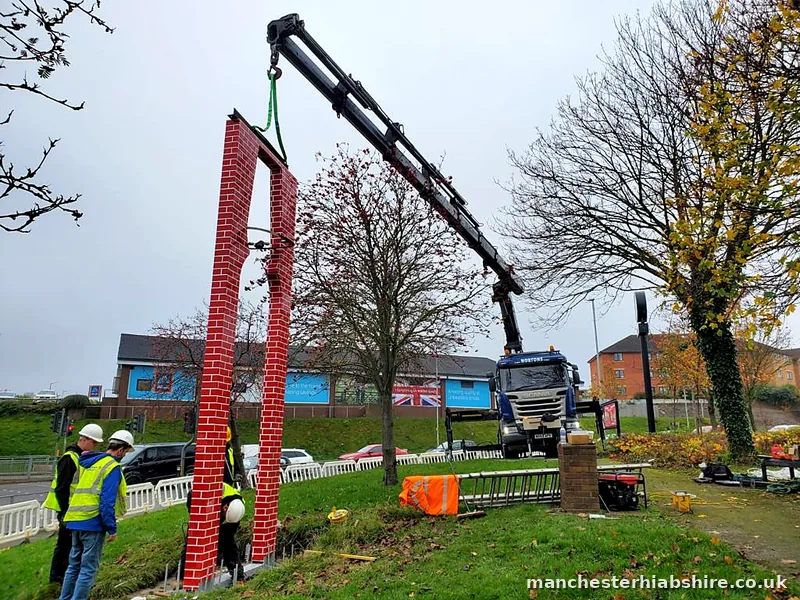
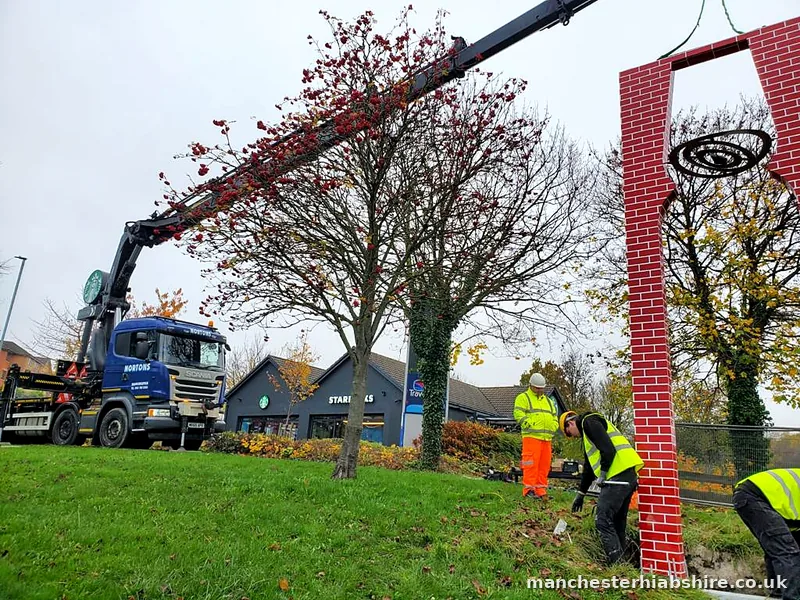
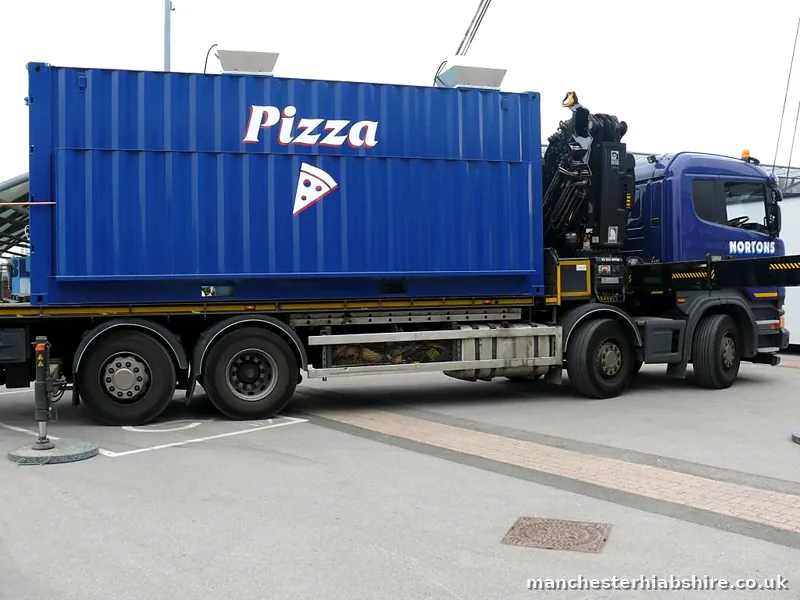
We carry it and install it on the same lorry. The unit comes off the bed on slings or chains, goes over whatever is in the way, and is lowered onto the base and held there while your fitters or the sign maker line it up and secure it. Nothing gets dragged, nothing sits on the ground overnight, and there is no forklift to arrange.
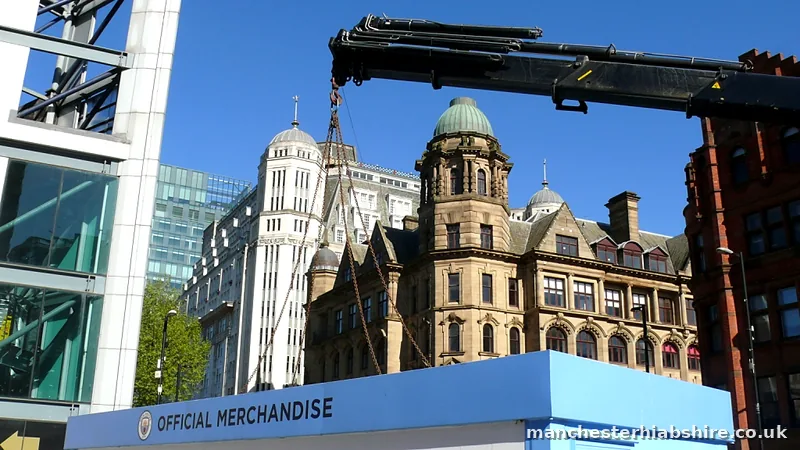
Most of it is retail, leisure, event and industrial work. Entrance signage at the front of a business park. Kiosks and pods for a retail scheme. Matchday units around the Manchester grounds. Timber chalets in and out for a Christmas market.
What we install
Signage and display work
- Entrance, monument and business park signage
- Totem and pylon signs set onto a prepared base
- Retail pods and small standalone shop units
- Event and matchday kiosks in and out to a fixture list
- Timber market chalets for Christmas and street markets
- Information points, ticket booths and welfare kiosks
- Display pieces and one-off promotional units
- Collection from the sign maker or fabricator on the way in
- Removal of an old sign on the same visit as the new one
- Early starts before a site, centre or street opens
Getting it square, first time
On a sign job the lift is short and the positioning is everything. So we take our time on the setting down. The driver brings it in slowly, your fitter checks it against the base or the bolts, and it stays on the hook until it is right. If it needs packing or shimming to sit level we will hold it while that goes in.
The other half of it is the surroundings. Paving you cannot track over, a forecourt in use, an overhead canopy, a shop frontage you cannot mark. Tell us about those when you email, and about how much room we have to stand the lorry, because that is what decides which vehicle comes.
Outdoor advertising work fits the HIAB well for the same reason: a billboard frame, a forecourt totem or a retail pod all have to be carried in and then lifted precisely into position, and doing both from one vehicle keeps the site closed off for the shortest time.
Common questions
Sign installation, answered
Do you install the sign or just deliver it?
Both, and that is the point of using a HIAB. The lorry carries the sign and lifts it, so it goes from the bed straight into position and is set down and levelled where it has to stand. There is no second visit and nothing left at the gate for somebody else to deal with.
Can you fix it down as well?
We place it, hold it and level it. Bolting down, grouting in or connecting anything up is normally done by your fitters or the sign maker while we hold the weight on the hook. That works well because we are not in a hurry and the unit is not going anywhere until they are happy with it.
Do the foundations need to be ready?
Yes. The base, the pad or the bolt pattern needs to be in and cured before we come. If it is not, we end up parking the sign on the ground and coming back, which costs you two visits. Tell us the date the base will be usable and we will book around it.
What sort of display units do you move?
Entrance and monument signage, totem signs, retail pods, kiosks, market chalets, matchday and event units, and one-off display pieces. If it arrives as a finished unit and has to be lifted into place rather than built on site, it is our sort of job.
Can you work out of hours or on a closed site?
Often, yes, and on retail and event work it is usually the sensible way to do it. We are open Monday to Friday from six in the morning and Saturday mornings, and early starts before a centre or a street opens are common on this work. Ask when you email and we will tell you what we can do.
What do you need to know about the sign and the site?
The size and rough weight of the unit, where it is being collected from, where it is going, and what the access is like at the installation end. A photograph of the spot it has to sit in tells us most of what we need.
Related